
Enceladus is a small, bright, ice-covered moon with a global saltwater ocean beneath its crust; the ice shell is thick at the equator and mid-latitudes but thins at the south pole, where four long “tiger stripe” fractures vent geyser-like plumes into space.
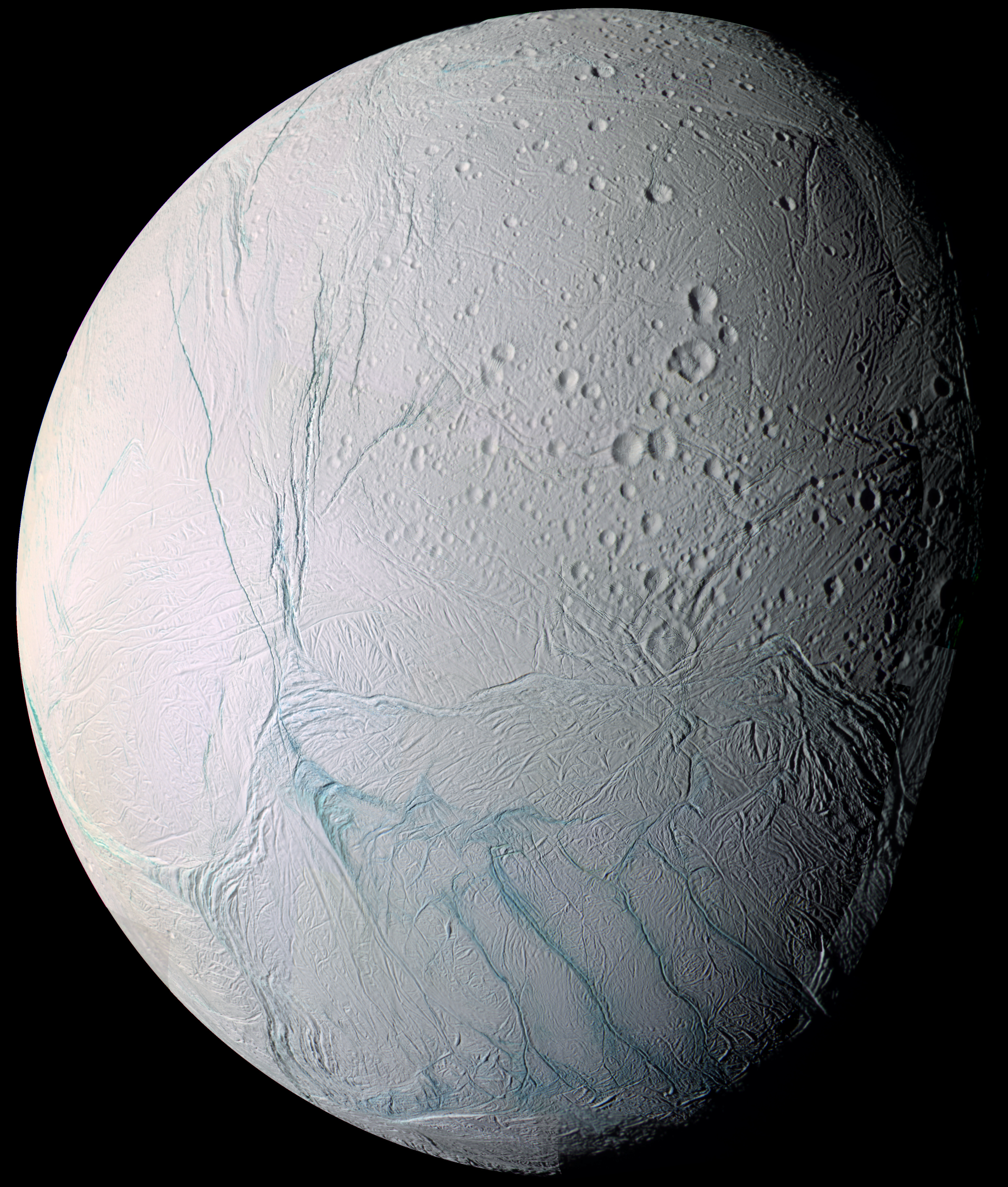
A false-color photo of Enceladus, that highlights its ridges, impact craters and plains. wikimedia 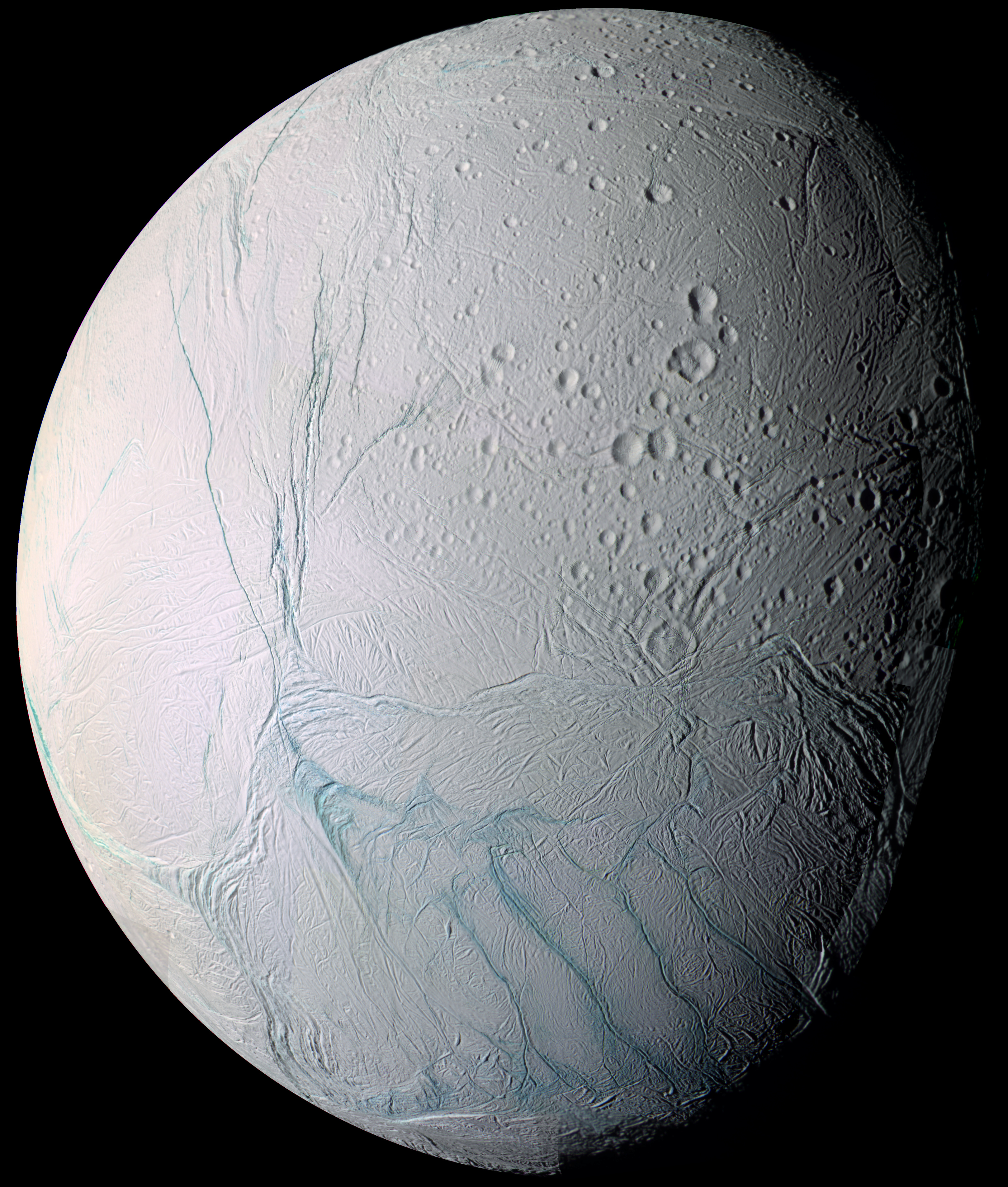
The south-polar terrain is the youngest and warmest, sculpted by tidal flexing into ridges, troughs, and fault-bounded blocks, and likely connected via fractures to a rocky seafloor hosting hydrothermal activity.
Away from the pole, older, more cratered plains are cross-cut by bands of ridges and grooves, while plume fallout mantles parts of the surface and supplies material to Saturn’s E-ring.
# Is Enceladus habitable? - Cassini found **molecular hydrogen (H₂)** in the south-polar plumes — a hallmark of water–rock reactions like those that power Earth’s hydrothermal-vent ecosystems. - Cassini also detected **nanograins of silica**, best explained by hot (>90 °C) water circulating through rock at the seafloor. - Most strikingly, reanalysis of Cassini dust data revealed **sodium phosphates** — direct evidence that **bio-essential phosphorus** is available in Enceladus’s ocean, likely at concentrations ≳100× those of Earth’s oceans. - Together with abundant organics and a salty global ocean, Enceladus checks many boxes for potential habitability.
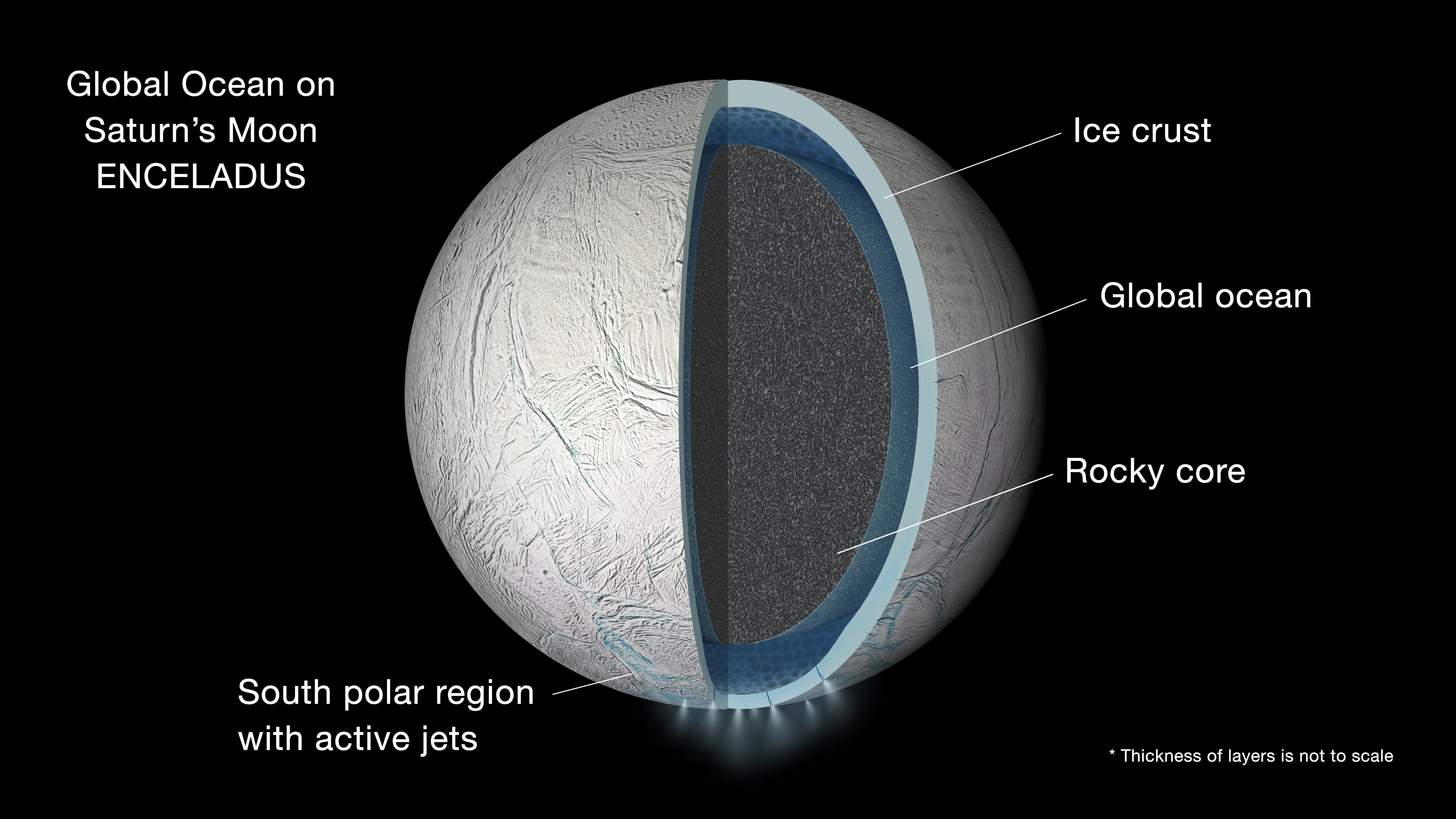
An artist's impression of a global subsurface ocean of liquid wate wikimedia 
# Sources
- Cassini detections of phosphates, silica nanograins, and H₂ (Nature 2023; Nature 2015; *Science* 2017) - nature  and science
- European Space Agency’s Enceladus priority under Voyage 2050 (ESA) - esa.int
and science
- European Space Agency’s Enceladus priority under Voyage 2050 (ESA) - esa.int
# See
- Is Moon Life possible Under the Seas?
- Enceladus Power, Titan Power and Ganymede Power
- Icy Moon Missions
- google.com/maps/space/enceladus/